Tornitura
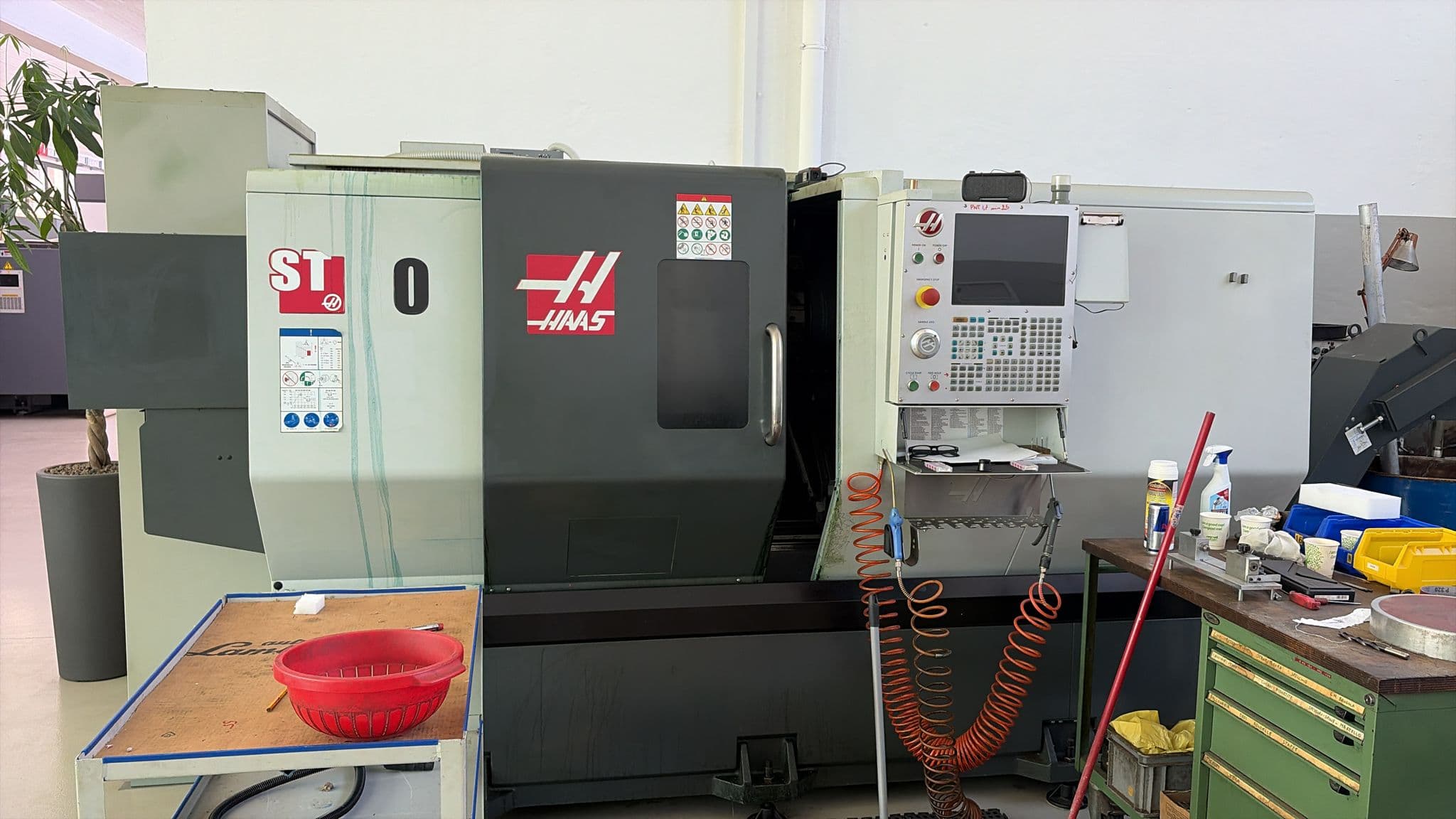
Haas ST-30Y lathe: Y axis, BMT-65 turret and what to check on a used one
· Industrialbuyer S.r.l.
The ST-30Y is the Y-axis version of the Haas ST range: fixed-head CNC lathes built in Oxnard, California. It comes as standard with the BMT-65 turret with live tooling, so besides turning it also mills and drills off the part axis, without moving the part to a machining centre. It is the middle size of the family, the one that covers most subcontract work.
What sets an ST-30Y apart (on the shop floor, not on the brochure)
- The Y axis is real, not simulated. The turret also moves vertically by 101.6 mm in total (±50.8 from centre). That means slots, flats and off-centre holes machined on the lathe in a single setup. Without a Y axis those same parts have to be taken off and re-fixtured on a mill: two setups, two chances to get it wrong.
- BMT-65 turret. The toolholder is bolted to the turret on a flanged face rather than on a plain shank: it holds torque better and vibrates less than a VDI when you are really milling. Live tools run up to 4,000 rpm.
- Haas control. On machines from roughly 2016 it is the NGC generation (Next Generation Control). A plain interface and on-machine programming: an operator who has already run a Haas sits down and gets going.
- A solid spindle for the size. In the standard configuration: A2-6 nose, 3,400 rpm, 22.4 kW and 407 Nm peak torque. It takes serious cuts in steel, this is not a light-parts-only machine.
- Parts and service. Haas is a widely used brand in Europe too, and on a used machine that matters more than it sounds: downtime lasts as long as the part you are waiting for.
Reading the ST range designations
The number after ST is the size: it goes from ST-10 (the smallest, bar work) up to ST-45. The number is not a measurement in millimetres or inches, it is a family code.
| Designation | What it adds |
|---|---|
| ST-30 | the base machine: turning, static tool turret |
| ST-30Y | Y axis + BMT-65 turret with live tooling |
| SS (e.g. ST-30SS) | Super Speed: faster spindle and higher rapids, for small parts and short cycles |
| BB (e.g. ST-30BB) | Big Bore: larger bar capacity, for heavy bar stock |
| DS (e.g. DS-30Y) | Dual Spindle: a different family, with the sub-spindle the ST does not have |
Two practical consequences:
- The ST-30Y comes with a driven turret: the Y designation stands for that configuration, Y axis and BMT-65 together. On a used machine the question is not whether live tooling is fitted, but how many driven toolholders come with it.
- An ST cannot finish the back of the part automatically: it has no sub-spindle. If you need to machine the back without unloading the part, the right machine is a DS, not an ST.
ST-30Y figures
| Item | Value |
|---|---|
| Turret travels (X / Y / Z) | 239 / ±50.8 / 584 mm |
| Maximum turning diameter | 349 mm |
| Maximum turning length | 584 mm |
| Bar capacity | 76 mm |
| Chuck | 254 mm (10 inch) as standard |
| Spindle | A2-6, 3,400 rpm, 22.4 kW, 407 Nm |
| Turret | BMT-65, 12 stations, live tools up to 4,000 rpm |
| Rapid traverse | 12 / 12 / 24 m/min |
These are the model's standard figures: on a used machine they should always be checked against the machine itself, because equipment and options vary from one unit to the next.
Notes from the used market — what to look at on a Haas ST-30Y
When I look at a used one I start from three things: how worn it is, the noise it makes and how clean it is. The noise tells you the most: a machine that has been looked after is quiet underneath. And a clean machine, nine times out of ten, is a machine somebody has taken care of on the inside too.
There are no typical faults on these machines: there is wear, and that is it. What keeps the value up over time is always the same two things — condition and age: an ST-30Y with few years on it holds them.
People look for it because of the Y axis and the brand, but there is a third reason you will not find written anywhere: whoever already has other Haas machines wants to stay with Haas. Same control, same habits: the operators do not have to relearn anything and the machine goes into production straight away.
Who it suits and typical work
This is a machine for subcontract shops and for departments running medium batches: shafts, flanges, valve bodies, fittings, parts from billet or from bar up to 76 mm that need a milled feature, a slot or an off-axis hole on top of the turning. On those part numbers the Y axis removes the second setup, and that is where the ST-30Y pays for itself: fewer setups, fewer re-fixturings, fewer chances to miss a dimension.
Frequently asked questions
What is the difference between a Haas ST-30 and an ST-30Y?+
The Y stands for the Y axis: the turret also moves vertically by 101.6 mm in total (±50.8 from centre). On the ST-30Y it comes together with the BMT-65 turret and live tooling, so the machine mills and drills off the part axis as well. The base ST-30 only turns.
Does the Haas ST-30Y have live tooling as standard?+
Yes: the Y designation stands for the configuration with Y axis and the 12-station BMT-65 turret, with live tools up to 4,000 rpm. On a used machine the question to ask is not whether live tooling is fitted, but how many driven toolholders are actually included with it.
Can the ST-30Y machine the back of the part as well?+
Not automatically: the ST range has no sub-spindle. To finish the back without unloading the part you need the DS family (a DS-30Y for instance), which has two opposed spindles. On an ST the back is done in a second operation.
Which control does a used Haas ST-30Y have?+
The control is Haas. On machines from roughly 2016 it is the NGC generation (Next Generation Control), with a redesigned screen and interface compared with the classic control. Older machines carry the previous generation: the programming logic is the same, the screen and some functions differ.
What should you check before buying a used ST-30Y?+
Condition, how noisy it runs and general cleanliness: those three tell you how it has been kept. Then the data that affect the deal: year, running hours, control version, how many live toolholders and which accessories are included (tailstock, bar feeder, high-pressure coolant, chip conveyor).
How big a part can an ST-30Y take?+
The model’s standard figures are 349 mm maximum turning diameter and 584 mm maximum turning length, with 76 mm bar capacity and a 254 mm (10 inch) chuck as standard. On a used unit the fitted chuck may differ and should be checked on the machine.