
Tornitura
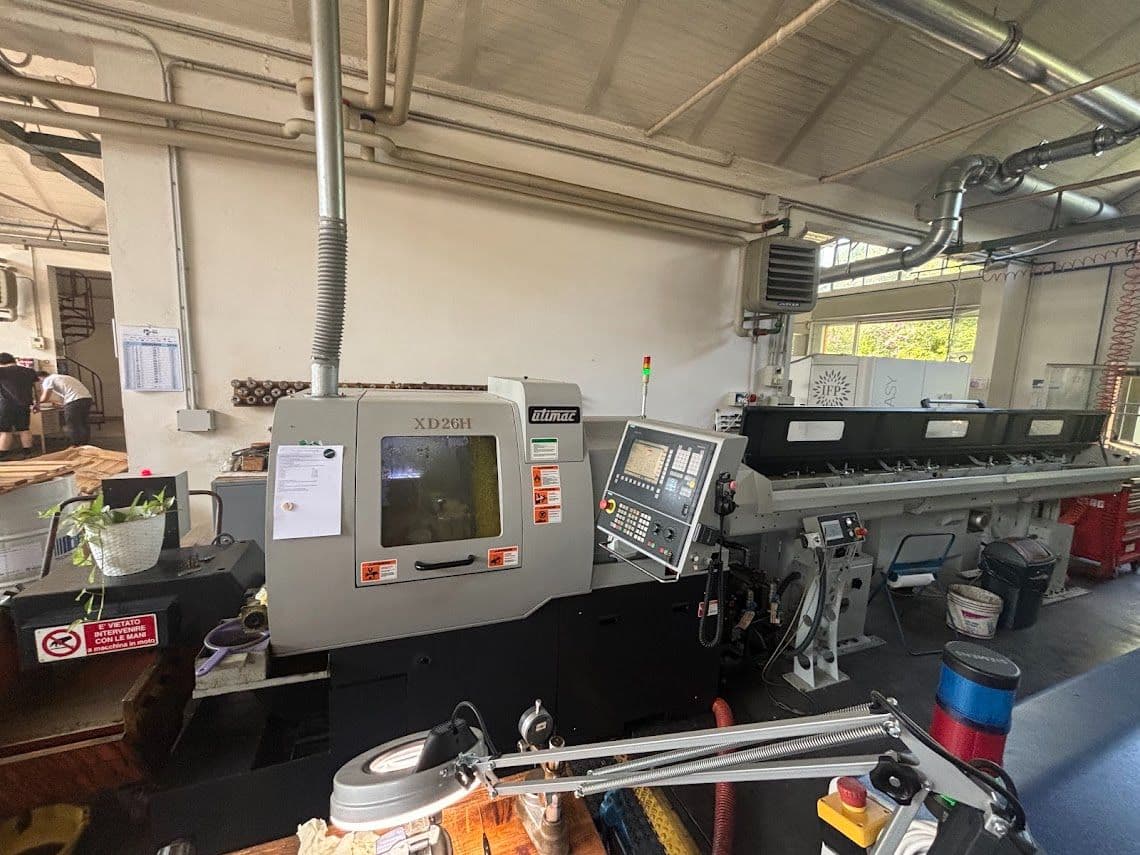
Hanwha XD26 series: Swiss-type CNC lathe — models, spindle power and what to check on a used machine
· Industrialbuyer S.r.l.
Hanwha builds Swiss-type CNC automatic lathes in Changwon, South Korea — the machines that turn bar work in volume up to Ø38 mm, fed from a barfeeder and often running lights-out. On the used market you find models from 12 mm up to 38 mm bar capacity. They are a strong choice for anyone producing small precision parts, fittings, hydraulics, medical components and automotive parts.
What sets them apart, on the shop floor
- The XD26 series runs 5 linear and 4 rotary axes, with two C axes and two spindles: while the main spindle roughs the new part, the sub-spindle finishes the previous one. The part comes off complete — no second op on another machine.
- The guide bush. It supports the bar a few millimetres from the tool: that is what lets you turn long and slender without deflection. On the XD26 it comes synchronised “full stroke” or self-adjusting, and it is pressurised and rotating.
- Up to 26 tools, 12 of them driven. On the vertical tool plate: 6 turning stations (12×12) and 4 ER16 driven tools up to 6,000 rpm. At the back: 4+5 tools, of which 2+2 can be driven up to 8,000 rpm. Drilling, milling and threading are done with the part still in the machine.
- The Siemens version is a different machine. The XD 26H-840D runs a Siemens 840D control and carries 6.8 kW on the main spindle and 4 kW on the sub-spindle, against 3.7/5.5 kW and 1.5/2.2 kW on the Fanuc-equipped XD 26J and XD 26H. The maker claims +60% power over the competition: that is where the figure comes from.
- High-pressure coolant. It breaks the chip and cools the tool at the bottom of deep holes. On long parts it is not an option — it is essential.
- Cast-iron base, linear guideways, ball screws and super-precision bearings: the base absorbs the vibration, and you see it in the finish and in tool life.
- Options that change the work you can take on: thread whirling (tourbillonnage), polygon turning, long-part ejection through the sub-spindle, tool and tap breakage detection, rigid tapping.
Models you meet on the used market
| Model | Bar capacity | Control | Main / sub-spindle |
|---|---|---|---|
| XD 26J | Ø26 mm | Fanuc | 3.7-5.5 kW / 1.5-2.2 kW — no driven tools at the back |
| XD 26H | Ø26 mm | Fanuc | 3.7-5.5 kW / 1.5-2.2 kW — with driven tools at the back (2+2 ER16) |
| XD 26H-840D | Ø26 mm | Siemens 840D | 6.8 kW / 4 kW — the most powerful of the series |
The whole XD26 series shares a 210 mm headstock stroke, 32 m/min rapids, a 2,000×1,200 mm footprint and 2,700 kg. The number in the model name is the maximum bar diameter; the final letter identifies the version.
Notes from the used market — what we look at on a Hanwha
First thing: what coolant it ran on. On a sliding-headstock lathe it matters that the machine ran on straight oil. With emulsion, the water creates condensation and condensation rusts the internal parts. That is one of the reasons why, when emulsion is used, the oil percentage is kept higher: to limit condensation.
Build quality is among the best on the market. And on the XD 26H the choice of a Siemens control is a plus: for the same motor size, Siemens delivers up to 60% more power than Fanuc. Stronger in metal removal, faster over short moves.
There are no typical faults: only wear. There is no built-in defect waiting for you.
What keeps the value up is condition and performance. The rest counts for little.
Who it suits and typical work
If you produce turned parts in volume, an XD26 finishes them in a single cycle: barfeeder in line, complete part at the unloader. The real step up on machines like these is being able to make parts that other machines cannot handle, thanks to the power available, and to cut cycle times significantly.
Frequently asked questions
What bar capacity do they handle?+
Ø26 mm on the XD26 series. On the used market Hanwha models range from 12 mm to 38 mm bar capacity.
What is the difference between XD 26H and XD 26H-840D?+
The control: Fanuc on the first, Siemens 840D on the second, with a 6.8 kW main spindle instead of 3.7/5.5 kW and a 4 kW sub-spindle instead of 1.5/2.2 kW.
Straight oil or emulsion?+
Straight oil. With emulsion, condensation rusts the internal parts; if emulsion is used, a higher oil percentage is kept.
What should you check first on a used Hanwha?+
What coolant it ran on, its condition and its real performance.
Are they on a par with Citizen, Star and Tsugami?+
It is a brand that has earned its standing over time; on the Siemens version the available power is higher.